
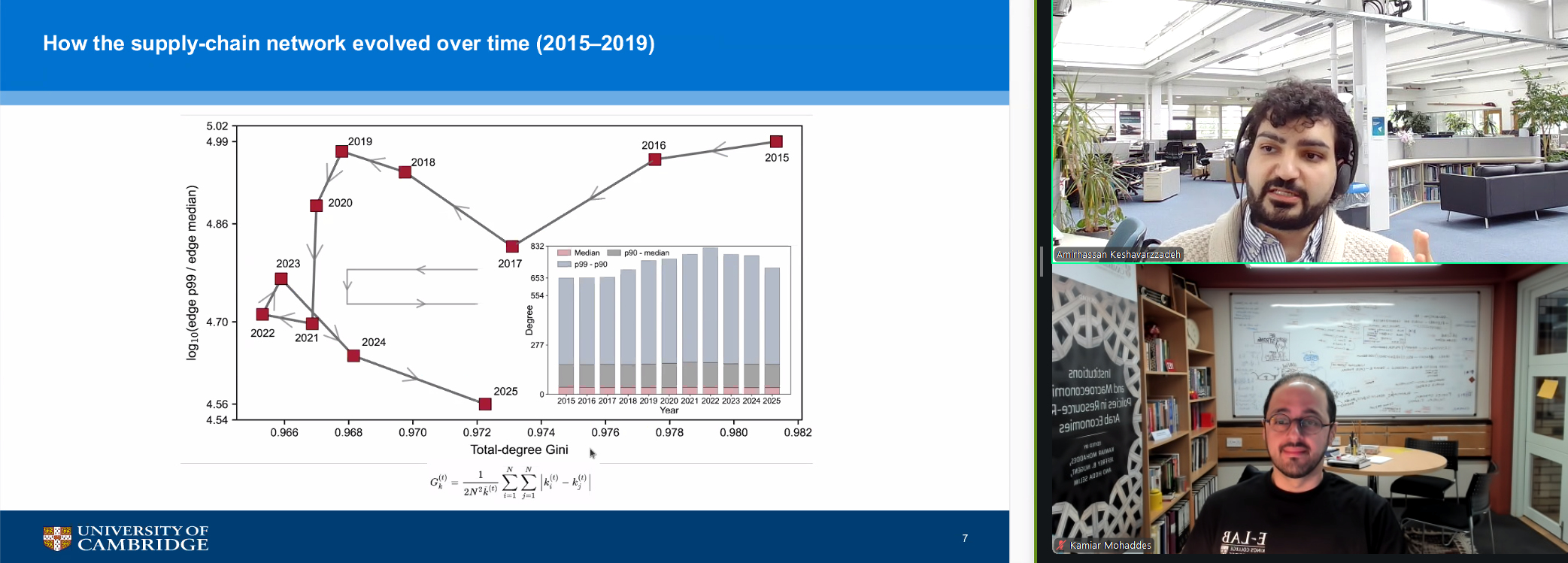
Amirhassan Keshavarzzadeh (University of Cambridge) will be presenting his work on “Tariffs and the Reallocation of Global Production Networks: Firm-Level Evidence on Heterogeneity and Contagion Risk over the Past Decade”.
About this session: Over the past decade, global production networks have been repeatedly exposed to trade shocks, from escalating tariff disputes to a broader return of protectionism. Yet the firm-level consequences of these shocks remain poorly understood. Firms differ substantially in their suppliers, customers, market power, geographic exposure, and ability to reorganise production. As a result, the same tariff shock can trigger very different responses across firms, with consequences that may extend far beyond the firms directly affected. This study uses large-scale firm-level supply chain data to examine how tariff shocks have reshaped global production networks over the past decade. It investigates how firms reallocated suppliers and customers in response to trade frictions, how these responses differed across firms, sectors, and countries, and whether this reallocation has made the global production system more resilient or more vulnerable to contagion risk.
When: Monday 18th of May
12.30-13.45 Talk and Q&A.
Where: Online only, join us virtually on Zoom.
The weekly climaTRACES workshops,organised by Kamiar Mohaddes and Henning Zschietzschmann, are attended by a diverse group of people from economics, geography, politics, engineering, business, earth sciences, natural sciences, and history, generating interdisciplinary discussion. One person leads the session, on either a paper they have written, a work in progress, or just an idea they have and would like feedback on. This is also an opportunity for people to find our more about the team on what climaTRACES have been up to and what future events and research projects are being developed.